

KitchenAid Microwave Oven Combo Would Not Power On — Electrical Diagnosis and Door Safety System Repair
Verified Repair Report™ #0006
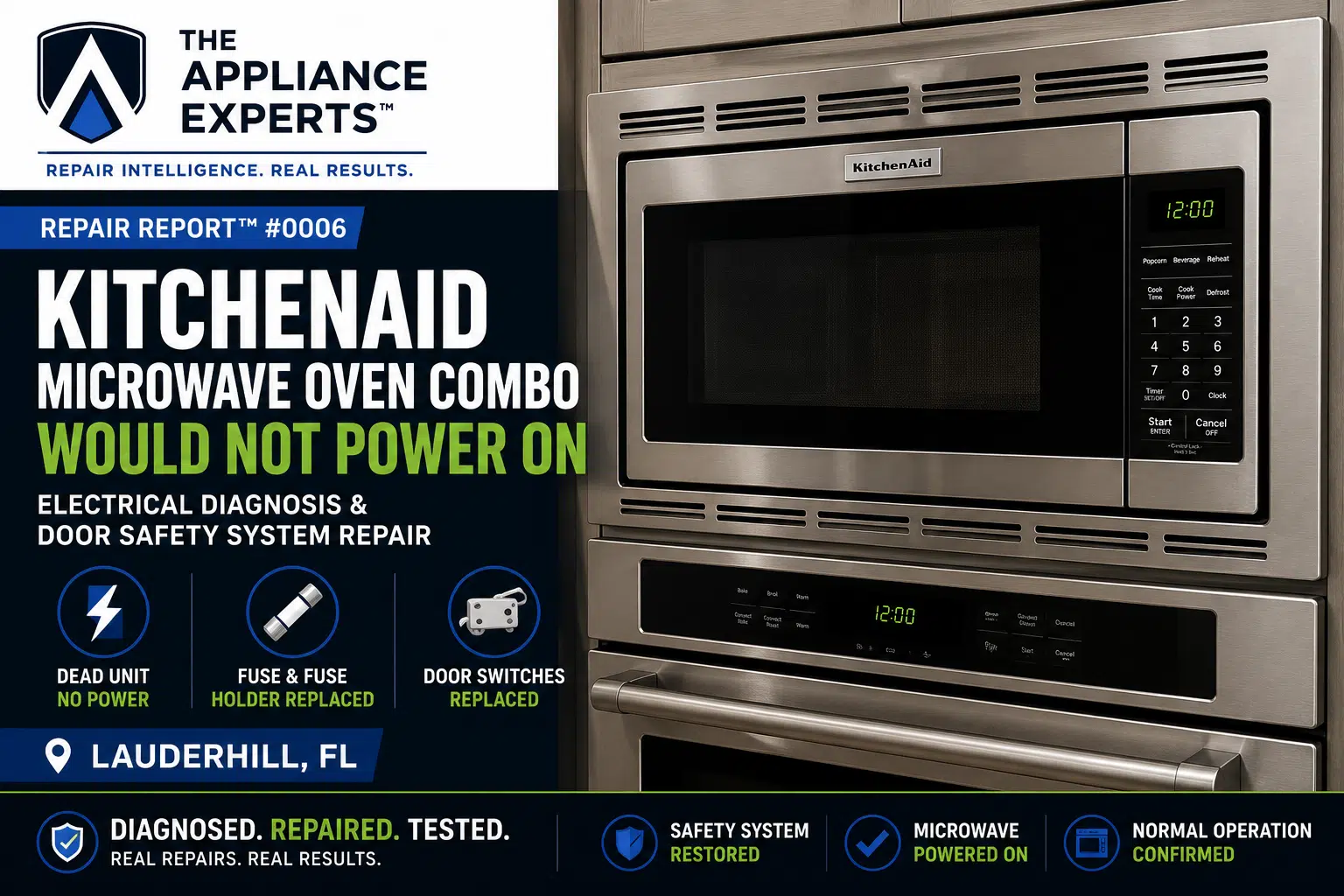
The customer reported the microwave was completely dead and would not power on.
Electrical diagnosis determined the protective fuse had opened, and further inspection revealed damage to the fuse housing along with worn door safety switches.
The technician replaced the complete group of failed components to restore safe and reliable operation.
🟢 Repair Completed Successfully
Service Overview
| Brand: | KitchenAid |
| Appliance: | Built-In Microwave / Wall Oven Combo |
| Model: | Not Available |
| Problem Reported: | Microwave completely dead and would not power on |
| Diagnosis: | Failed fuse, damaged fuse housing, and faulty door switch assembly |
| Repair Performed: | Replaced fuse, fuse holder, and door switches |
| Outcome: | Repaired Successfully |
| Repair Complexity: | Moderate–High |
| Location: | Lauderhill, FL |
| Repair Report #: | 0006 |

Customer Complaint
The customer reported the microwave was completely dead and would not power on.
Symptoms Reported:
⚠️ Microwave completely dead
⚠️ No display
⚠️ No interior light
⚠️ No response from control panel
⚠️ Unit would not start

Technician Inspection
The microwave showed no signs of power during initial testing. Electrical diagnosis determined the protective fuse had opened. Further inspection revealed damage to the fuse housing along with worn door safety switches.
Because the door interlock system is a critical safety component, replacing only the fuse would likely have resulted in another failure.

Failure Analysis
Electrical / Safety Circuit Failure
Microwave ovens contain several safety devices designed to interrupt power if the door interlock system does not operate correctly.
When a door switch sticks, becomes misaligned, or fails electrically, it can cause excessive current flow during operation or while opening and closing the door. This often damages the main fuse or fuse holder, leaving the microwave completely without power.
Replacing only the fuse without identifying the underlying cause frequently results in repeated failures.

Repair Performed
🟢 Successful Repair Completed
The technician completed the following service steps:
✔ Verified incoming power
✔ Tested microwave electrical circuit
✔ Replaced failed fuse
✔ Replaced damaged fuse holder
✔ Installed new door switch assembly
✔ Tested door safety operation
✔ Verified proper microwave operation
In this case, replacing the fuse, fuse housing, and door switches restored normal operation while correcting the underlying electrical fault.
Technician Assessment
Repair Complexity: 🟠 Moderate–High
Diagnostic Difficulty: High
Parts Replaced:
- Microwave Fuse
- Fuse Holder / Housing
- Door Switch Assembly
Repair Recommendation:
🟢 Repair Completed Successfully
Although replacing a fuse is simple, identifying why the fuse failed requires electrical troubleshooting. This repair involved diagnosing multiple related failures within the microwave's electrical safety system, including the fuse holder and door interlock switches. Proper testing is essential because these components protect the appliance from operating when the door is not securely closed.

Homeowner Tip
Don't just replace the fuse.
If your microwave suddenly appears completely dead with no display or lights, avoid repeatedly replacing the fuse yourself.
The fuse is usually protecting the appliance from another electrical problem, such as a faulty door switch or damaged fuse holder. A proper diagnosis helps prevent repeat failures and unnecessary parts replacement.
Preventive Maintenance Tips
Help preserve the lifespan of your microwave's safety switches:
✅ Close the Door Gently
Slamming the microwave door can prematurely damage or misalign the delicate safety interlock switches over time.
✅ Keep the Latch Hooks Clean
Wipe down the door hooks and latch area to prevent grease and food debris from sticking and interfering with the switch operation.
✅ Stop Before You Open
Whenever possible, press the "Stop" or "Cancel" button to end the cycle before pulling the door open. Yanking the door open while the microwave is actively running forces the safety switches to break the electrical current under load, accelerating wear.
Machine Information
Brand: KitchenAid
Appliance: Built-In Microwave / Wall Oven Combo
Repair Report: 0006
Repair Status: ✔ Service Completed Successfully
Location: 📍 Lauderhill, Florida

Repair Classification
🟠 Moderate–High Repair

Reliability Index Entry
| Brand | Appliance | Failure | Root Cause | Repairable |
|---|---|---|---|---|
| KitchenAid | Built-In Microwave | Fuse / Door Switches | Electrical Safety Circuit Failure | Yes |

Frequently Asked Questions
1. Why is my KitchenAid microwave completely dead?
If the microwave has no display or lights, the main protective fuse has likely opened to protect the appliance from an electrical fault, such as a sticking door safety switch.
2. Can I just replace the microwave fuse if it won't turn on?
Replacing only the fuse without identifying the underlying cause frequently results in repeated failures. The fuse usually blows because of a secondary issue, like worn door interlock switches that must also be replaced.
3. What parts were replaced during this repair?
To ensure safe and reliable operation, the technician replaced the microwave fuse, the damaged fuse holder, and the door switch assembly.

Continue Exploring
Related Repair Reports:
🚪 Whirlpool Microwave Door Latch Repair (RR0016)
Appliance Repair Services:
🛠️ KitchenAid Appliance Repair
⚙️ Door Switch Replacement
Appliance Care Resources:
♨️ Microwave Not Heating
🚪 Microwave Door Won't Close
🛑 Microwave Turns Off During Cooking
⚡ Microwave Trips Breaker
Need Microwave Oven Repair?
If your appliance is having a similar problem, The Appliance Experts can help diagnose the issue and explain your repair options.
📞 (954) 256-1622 Call or Text★★★★★ Trusted by South Florida Homeowners.
✔ Honest Recommendations
✔ Experienced Technicians
✔ Detailed Repair Reports
Serving Broward, Miami-Dade & Palm Beach County
The Appliance Experts
Trusted appliance repair professionals serving homeowners throughout South Florida with expert repairs, genuine replacement parts, and detailed Repair Reports™.
Repair Reports™ are based on actual technician service calls performed by The Appliance Experts. Individual appliance failures and repair recommendations may vary.
© 2026 The Appliance Experts. All Rights Reserved.
Privacy Policy | Terms of Service | Contact Us