

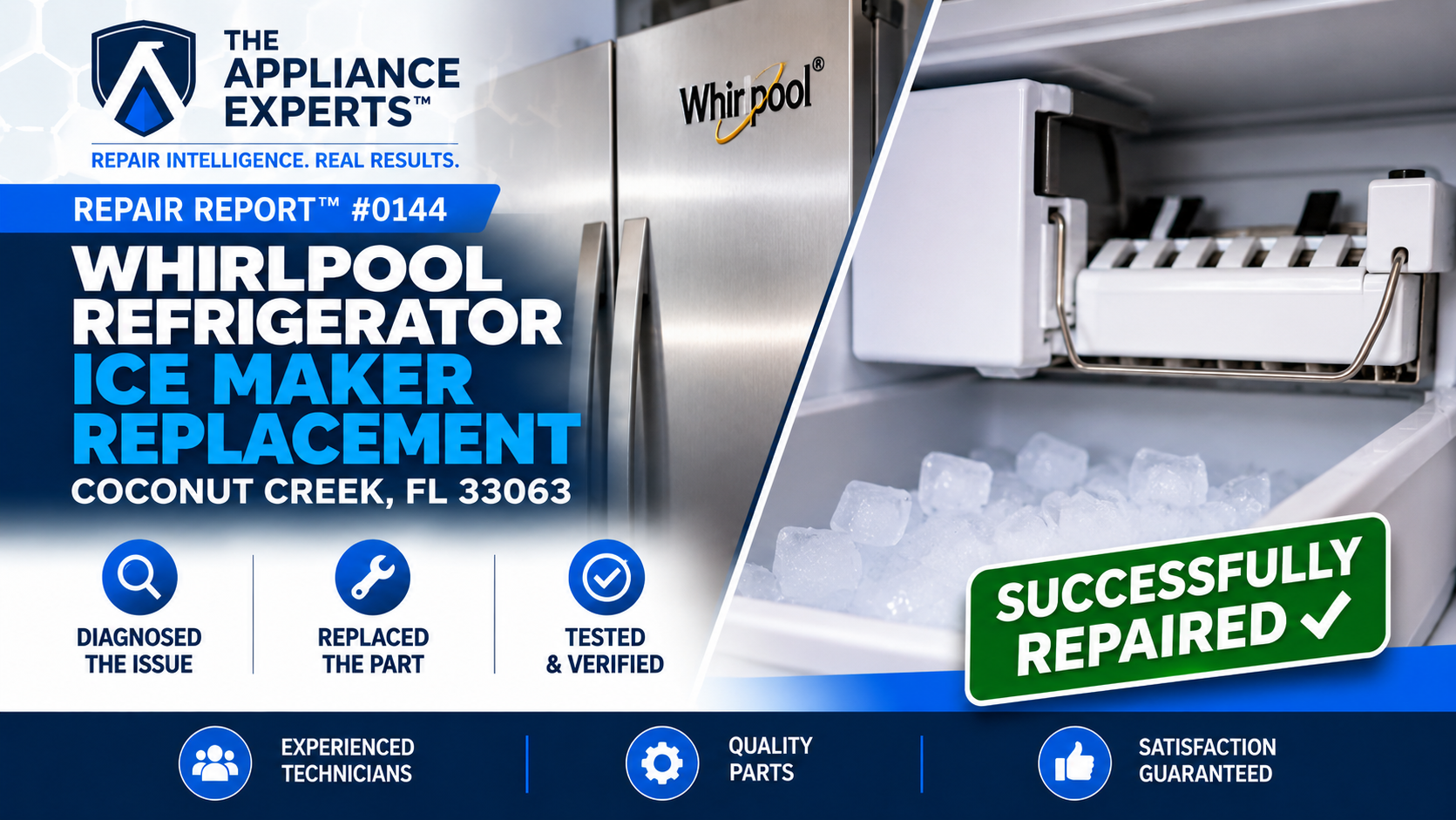
Whirlpool Refrigerator Ice Maker Replacement in Coconut Creek, FL
Verified Repair Report™ — RR0144
Service Summary
- Appliance Category: Refrigerator
- Brand: Whirlpool
- Model Number: GS5SHAXNL00
- Service Location: Coconut Creek, FL 33063
- Primary Symptom: Not specifically documented
- Diagnosis: Bad Ice Maker
- Repair Performed: Ice Maker Replaced
- Repair Status: Successfully Repaired (Making Ice)
The customer's original description of the refrigerator problem was not specifically preserved in the available service documentation.
The technician's diagnosis, however, was clear:
The refrigerator had a bad ice maker that needed replacement.
The service record subsequently documents installation of the replacement component and, importantly, what happened afterward:
The refrigerator was making ice.
That gives RR0144 a complete evidence chain:
Bad ice maker diagnosed → ice maker replaced → ice production restored
Service Overview
| Brand: | Whirlpool |
| Appliance: | Refrigerator |
| Model: | GS5SHAXNL00 |
| Problem Reported: | Not explicitly documented |
| Diagnosis: | Bad ice maker |
| Repair Performed: | Ice maker replaced |
| Outcome: | Successfully Repaired (Making ice) |
| Repair Complexity: | Moderate |
| Technician: | The Appliance Experts |
| Repair Report #: | 0144 |

Refrigerator Identification
A field identification photograph documents the appliance as a:
Whirlpool Refrigerator
Model GS5SHAXNL00
The manufacturer's label shows a manufacture date of:
August 2005
This makes RR0144 particularly useful from a Repair Intelligence™ perspective because the refrigerator was approximately 21 years old at the time of this 2026 service event.
Despite its age, the documented problem involved a specific replaceable component rather than a documented compressor or sealed-system failure.

Diagnosis
The technician diagnosed the refrigerator with a bad ice maker.
An automatic refrigerator ice-making system depends on several conditions and components working together. Depending on the refrigerator design, those can include:
• Ice-maker assembly
• Water supply
• Water inlet valve
• Fill tube
• Freezer temperature
• Electrical connections
• Shutoff mechanisms
• Refrigerator controls
Because several different problems can interrupt ice production, a refrigerator that isn't making ice does not automatically need a new ice maker.
In RR0144, however, the technician specifically identified the ice maker itself as the failed component.

Repair Performed
The failed ice maker was replaced.
The service documentation records:
“Parts installed and making ice.”
This establishes both the component replacement and a functional post-repair result.
The repair was therefore not left at the diagnosis or installation stage. The refrigerator's ice-making function was documented operating after the repair.
Post-Repair Result
RR0144 contains three distinct pieces of service evidence:
• Diagnosis: Bad ice maker
• Repair: Replacement ice maker installed
• Outcome: Refrigerator making ice
That final step is what allows this report to be classified as: Successfully Repaired.
Within the Verified Repair Reports™ methodology, a documented successful operating result provides stronger evidence than component installation alone.
What Does a Refrigerator Ice Maker Do?
An automatic ice maker repeatedly performs a sequence of operations.
Water must enter the ice mold in the correct amount. The water must freeze. The ice maker then has to complete a harvest cycle that releases the finished cubes into the ice bin.
After that process is complete, the system can begin another cycle.
A problem at several different points in that sequence can stop or reduce ice production.
Ice Maker vs. Water Inlet Valve
An ice maker and water inlet valve perform different functions.
The ice maker controls important portions of the ice-making and harvesting process.
The water valve controls water entering the refrigerator's water-dependent systems when commanded.
A refrigerator can therefore fail to make ice because the ice maker itself has failed, because water isn't reaching it correctly, or because of another problem entirely.
Replacing an ice maker without determining that it is actually defective can result in an unnecessary repair. RR0144 documents a technician diagnosis of the ice maker followed by successful ice production after replacement.
Ice Maker vs. Freezer Temperature Problem
Ice production also depends on sufficiently cold freezer conditions.
A refrigerator may have a functional ice maker but still experience poor or nonexistent ice production if freezer temperatures aren't appropriate.
That creates another important diagnostic distinction.
Before assuming the ice maker itself has failed, the overall condition of the freezer and ice-making system should be considered.
In this Coconut Creek service event, the documented repair was the ice maker itself.
Why Post-Repair Ice Production Matters
A replacement part being installed doesn't automatically prove that the original problem has been resolved.
For example:
Part installed tells us the repair was performed. Making ice afterward tells us something about the result.
RR0144 includes both. That allows the repair record to progress from: Diagnosis to Completed Repair to Verified Successful Repair.
This distinction is central to how The Appliance Experts™ classifies service outcomes.
Repair vs. Replacement on an Older Refrigerator
The Whirlpool identification label dates this refrigerator to August 2005.
At approximately 21 years old, appliance age naturally becomes part of the repair-versus-replacement discussion.
But age alone doesn't answer the question. Other considerations include:
• What component failed
• Overall refrigerator condition
• Cooling-system condition
• Parts availability
• Repair cost
• Energy use
• Whether other significant failures are developing
• Cost of a comparable replacement refrigerator
An older refrigerator with an isolated ice-maker failure presents a very different repair decision from an older refrigerator with a failed compressor or multiple major problems.
RR0144 demonstrates that distinction clearly. The documented problem was component-specific. The component was replaced. And the refrigerator was documented making ice afterward.
Does a 21-Year-Old Refrigerator Automatically Need Replacement?
No universal age cutoff determines when every refrigerator should be replaced.
Age is an important factor because the probability of additional component wear generally becomes more relevant as an appliance gets older.
But the actual failure still matters. Consider two hypothetical refrigerators of the same age:
Refrigerator A: Failed ice maker
Refrigerator B: Major sealed-system failure plus additional problems
Those are not equivalent repair decisions merely because both appliances were manufactured in the same year. Component-level diagnosis provides the context that appliance age alone cannot.

Repair Intelligence™
RR0144 contributes a particularly useful successful-repair event to The Appliance Experts™ Repair Intelligence™ records.
• At the appliance level: Whirlpool Refrigerator
• At the system level: Ice-Making System
• At the component level: Ice Maker
• At the repair level: Ice Maker Replacement
• At the outcome level: Successfully Repaired — Making Ice
The appliance's manufacture date adds another useful dimension: August 2005.
The service event therefore records:
1 older Whirlpool refrigerator → 1 failed ice maker → 1 completed component replacement → successful ice production afterward
This supports one of the recurring patterns behind Repair Intelligence™:
The appliance tells you where the problem occurred. The failed component—and the economics surrounding it—often tells you whether repair makes sense.
Comparing RR0144 With Major Refrigerator Failures
A refrigerator service call can lead to dramatically different repair paths depending on the component involved.
A technician might diagnose: Ice maker, Evaporator fan, Temperature sensor, Control board, Water valve, Compressor, or Another sealed-system component.
All of those occur within the broad category of Refrigerator Repair. But they don't carry the same repair complexity, cost or repair-versus-replacement implications.
RR0144 involved an ice maker. That component-level detail tells us much more than simply recording that an older refrigerator required service.
Why a Refrigerator May Stop Making Ice
A refrigerator that stops producing ice can have several possible causes. Depending on the appliance, those can include:
⚠️ Failed ice-maker assembly
⚠️ Restricted water supply
⚠️ Clogged or restricted water filter
⚠️ Failed water inlet valve
⚠️ Frozen fill tube
⚠️ Freezer temperature problems
⚠️ Wiring or electrical faults
⚠️ Ice-bin or shutoff problems
⚠️ Control-system problems
That's why “not making ice” is a symptom, not a complete diagnosis. The component responsible for the symptom still has to be identified. For RR0144, that component was documented as the ice maker.
Helping an Ice Maker Operate Properly
Not every ice-maker failure can be prevented, but several surrounding conditions can affect ice production.
✅ Maintain proper freezer temperature: Ice production depends on sufficiently cold freezer conditions.
✅ Replace water filters appropriately: On refrigerators where the filter supplies the ice-making system, a severely restricted filter can reduce water flow.
✅ Check the water supply: Kinked tubing, closed valves or other supply restrictions can interfere with water reaching the refrigerator.
✅ Don't force the ice-maker mechanism: If the mechanism isn't moving normally, forcing it can cause additional damage.
✅ Watch for changing ice production: A significant change in ice quantity, cube size or cycling can provide useful diagnostic information.
What Homeowners Can Check Before Scheduling Service
Some basic observations may help narrow down an ice-production problem. You can note whether:
⚠️ The freezer is maintaining temperature
⚠️ The refrigerator is dispensing water normally, if equipped
⚠️ The ice maker contains ice but doesn't harvest it
⚠️ Water appears to be entering the ice maker
⚠️ The fill tube appears frozen
⚠️ Ice production stopped suddenly or gradually
⚠️ Unusual noises are coming from the ice-maker area
These observations don't replace diagnosis, but they can help describe the problem more accurately.
Machine Information
Brand: Whirlpool
Appliance: Refrigerator
Model: GS5SHAXNL00
Repair Report: 0144
Repair Status: 🟢 Successfully Repaired
Location: 📍 Coconut Creek, FL 33063

Repair Classification
🟢 Successfully Repaired (Making Ice)
Reliability Index Entry
| Brand | Appliance Category | Failure Mode | Failed Component / Condition | Repairability |
|---|---|---|---|---|
| Whirlpool | Refrigerator | Ice Maker / Ice System | Ice Maker | High (Component Replacement Completed) |

Frequently Asked Questions
Why did my Whirlpool refrigerator stop making ice?
Several conditions can interrupt ice production, including the ice maker itself, water-supply problems, a water inlet valve, restricted filter, frozen fill tube, freezer-temperature problems or electrical/control issues. RR0144 was specifically diagnosed with a bad ice maker.
Can a bad ice maker be replaced without replacing the refrigerator?
Yes, on many refrigerators the ice maker is a replaceable component. RR0144 is a real-world example: the failed ice maker was replaced and the refrigerator was documented making ice afterward.
Is an old refrigerator worth repairing if the ice maker fails?
It can be. The decision should consider the refrigerator's overall condition, cooling performance, parts availability, repair economics and whether other major failures exist. Age alone doesn't determine the answer.
Does a refrigerator that isn't making ice have a bad ice maker?
Not necessarily. Several other problems can produce the same symptom. Proper diagnosis is important before replacing the ice maker.
Can a clogged water filter stop ice production?
A severely restricted filter can reduce water flow on refrigerators where filtered water supplies the ice-making system. That doesn't necessarily mean the ice maker itself has failed.
Can a bad water valve look like a bad ice maker?
Yes. If the valve doesn't supply water when required, the ice maker may be unable to produce ice even if its mechanism is functional.
How long does a new ice maker take to start making ice?
Timing varies by refrigerator design, freezer temperature and operating conditions. The important evidence for RR0144 is that the service documentation explicitly states the refrigerator was making ice after the parts were installed.
Does an ice-maker failure mean the refrigerator's cooling system is failing?
No. The ice-making system and primary refrigeration system are related through freezer temperature, but an ice-maker component failure does not automatically indicate compressor or sealed-system failure.
Professional Diagnosis. Honest Repair Recommendations.™
Serving Coconut Creek, FL and the surrounding Broward County communities with transparent, reliable appliance repair.
Explore More Verified Repair Reports™
See more real appliance diagnoses and repairs in our Verified Repair Reports™ Hub. View Hub →

Continue Exploring
🔧 Related Repair Reports
❄️ Samsung Refrigerator Control Board Replacement Coconut Creek FL
❄️ Refrigerator Maintenance And Coil Cleaning In Coconut Creek FL
❄️ Frigidaire Refrigerator Water Dispenser Not Working Coconut Creek FL
🏠 Appliance Repair Services & Locations
🛠️ Refrigerator Repair Services
Need Refrigerator Repair?
If your appliance is having a similar problem, The Appliance Experts can help diagnose the issue and explain your repair options.
📞 (954) 256-1622 Call or Text★★★★★ Trusted by South Florida Homeowners.
✔ Honest Recommendations
✔ Experienced Technicians
✔ Detailed Repair Reports
Serving Broward, Miami-Dade & Palm Beach County
The Appliance Experts
Trusted appliance repair professionals serving homeowners throughout South Florida with expert repairs, genuine replacement parts, and detailed Repair Reports™.
Repair Reports™ are based on actual technician service calls performed by The Appliance Experts. Individual appliance failures and repair recommendations may vary.
© 2026 The Appliance Experts. All Rights Reserved.
Privacy Policy | Terms of Service | Contact Us