


REPAIR INTELLIGENCE™ | JANUARY–SEPTEMBER 2026
What Makes an Appliance Worth Repairing?
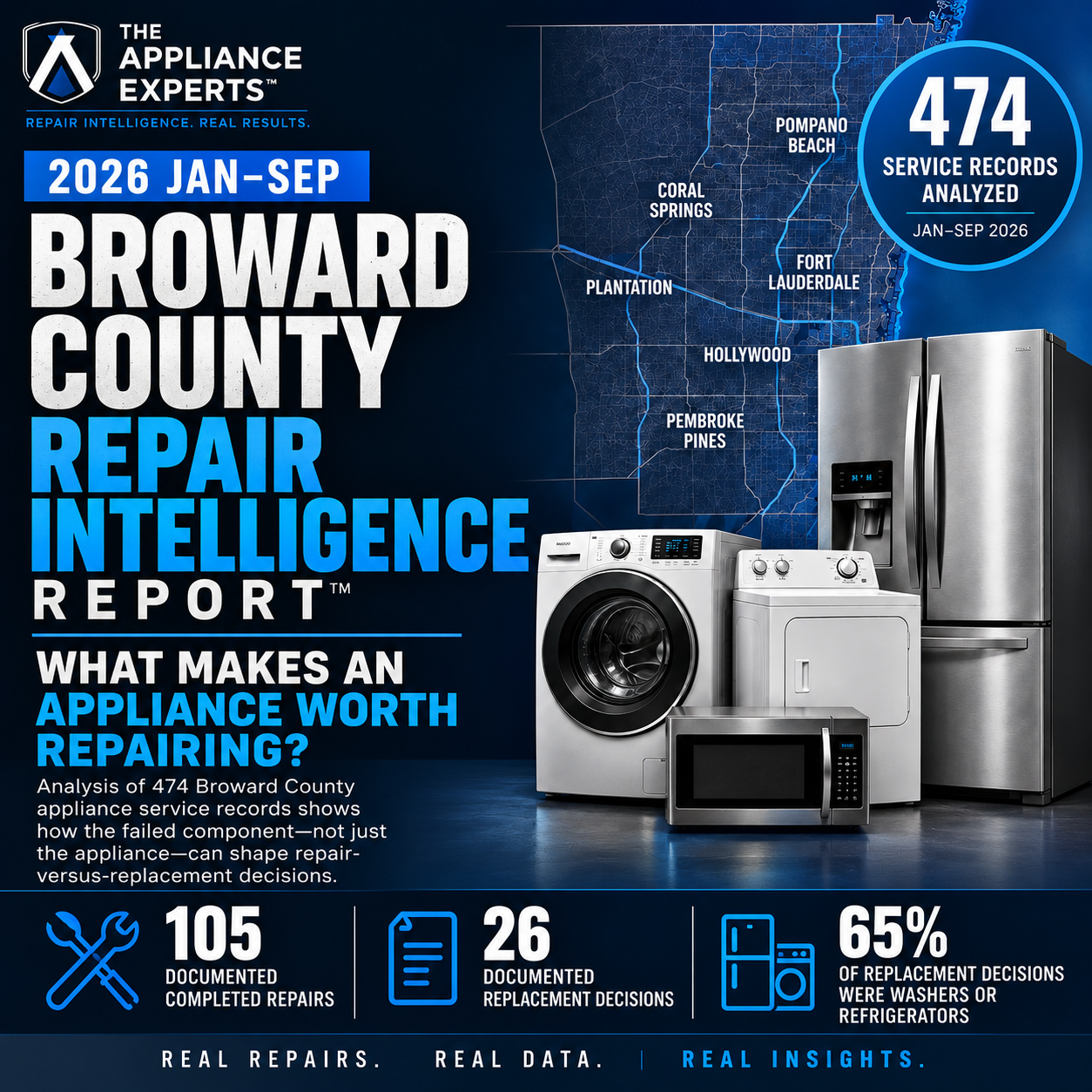
Analysis of 474 Broward County appliance service records shows how the failed component—not just the appliance—can shape repair-versus-replacement decisions.
Published by The Appliance Experts™
Repair Intelligence. Real Results.™
Broward County
Service Records Reviewed
Documented
Completed Repairs
Documented Appliance
Replacement Decisions
of Replacement Decisions
Involved Washers or Refrigerators
Executive Summary
When an appliance stops working, homeowners often begin with the same question:
Is it worth repairing—or should I replace it?
An analysis of 474 appliance service records created across Broward County from January 1 through September 30, 2026 suggests that the answer often depends on something more specific than the type of appliance.
It depends on what actually failed.
The Appliance Experts reviewed technician diagnoses, documented repairs, service outcomes and appliance-replacement decisions from service events across 24 Broward County municipalities.
The records show a recurring divide.
Component-level problems involving parts such as water valves, thermostats, heating elements, drain pumps, switches, belts, fans and other replaceable components frequently appeared in records where repair or corrective service remained practical.
Replacement decisions were more concentrated around major mechanical failures, compressor and cooling-system problems, unavailable critical electronics, extensive damage and situations where the economics of repair became unfavorable.
- 474 Broward County service records reviewed
- 105 records documenting completed repairs
- 36 of those completed repairs included explicit documentation confirming successful post-service operation or resolution
- 38 additional records documented corrective service or installation work
- 26 records included a documented appliance-replacement decision
- 17 of 26 replacement decisions involved either a washer or refrigerator
- 16 replacement decisions occurred during Q3
- 8 of 16 Q3 replacement decisions involved washing machines
- 6 of those 8 washer decisions involved major bearing/transmission-related mechanical problems
The data does not support a universal rule for deciding when an appliance should be repaired or replaced. Instead, it supports a more useful principle:
The appliance tells you where the problem occurred. The failed component—and the economics surrounding it—often tells you whether repair makes sense.
Building on the 2026 Mid-Year Report
This analysis expands The Appliance Experts’ 2026 Broward County appliance research beyond the completed-service population examined in the 2026 Mid-Year Broward County Appliance Failure Report™, using a broader record-level methodology to examine diagnosis, repair and replacement outcomes through September.
The Dataset
The analysis covers appliance service records created between January 1, 2026 and September 30, 2026.
The final normalized dataset contains 474 Broward County service records.
The records span 24 municipalities, including Fort Lauderdale, Coral Springs, Pompano Beach, Margate, Parkland, Coconut Creek, Tamarac, Sunrise, Hollywood, Lauderhill, North Lauderdale, Plantation, Oakland Park, Wilton Manors, Deerfield Beach, Davie, Weston, Miramar, Lauderdale Lakes, Pembroke Pines, Lauderdale-by-the-Sea, Dania Beach, Hallandale Beach and Lighthouse Point.
The largest concentrations of records were:
| Municipality | Service Records |
|---|---|
| Fort Lauderdale | 117 |
| Coral Springs | 84 |
| Pompano Beach | 50 |
| Margate | 46 |
| Parkland | 32 |
| Coconut Creek | 30 |
| Tamarac | 19 |
| Sunrise | 11 |
| Hollywood | 10 |
These records should not be interpreted as a population-level estimate of appliance failure rates within each city. They represent the geographic distribution of service records contained in the dataset.
How the Records Were Classified
Each service record was evaluated using the available technician notes, diagnosis, documented repair actions and outcome information.
Records were classified into mutually exclusive outcome categories.
- Verified successful repair or resolution
- Completed repair without an explicit post-repair operational test
- Corrective service or installation
- Diagnosis documented but repair not documented
- Appliance-replacement decision
- No mechanical failure or user-error outcome
- Mixed multi-appliance outcome
- Canceled service
- Insufficient or administrative evidence
Importantly, diagnosis was not treated as proof of repair.
A technician identifying a failed water valve, control board, motor or other component does not establish that the component was subsequently installed.
Similarly, payment by itself was not considered proof that an appliance was successfully repaired.
When the documentation was ambiguous, the record was not elevated into a stronger outcome category.
When the record is ambiguous, it doesn’t count toward the statistic.
What Happened Across 474 Service Records?
The normalized January–September analysis produced the following outcome distribution:
| Documented Outcome | Records |
|---|---|
| Diagnosis documented; repair not documented | 122 |
| Insufficient / administrative evidence | 113 |
| Completed repair; no explicit post-repair test documented | 69 |
| Canceled | 45 |
| Corrective service / installation | 38 |
| Verified successful repair / resolution | 36 |
| Appliance replacement decision | 26 |
| No mechanical failure / user error | 13 |
| Mixed multi-appliance outcome | 12 |
| TOTAL | 474 |
The distinction between completed repairs and verified successful outcomes is intentional.
There were 105 documented completed repairs:
36 verified successful repairs/resolutions
plus
69 completed repairs where installation or repair was documented but an explicit post-repair operational outcome was not recorded.
Another 38 service records documented corrective service or installation work.
These records are kept separate because corrective service can include work such as adjustments, unclogging, resets, mounting or installation corrections rather than conventional failed-component replacement.
Repair vs. Replace: What the Records Show
Only 26 of the 474 service records were classified as containing a documented appliance-replacement decision.
That does not mean only 26 appliances ultimately were replaced.
It means those are the records in which the available documentation supports saying that replacement was actually recommended, selected or otherwise documented as the outcome.
Among those 26 records:
| Appliance | Documented Replacement Decisions |
|---|---|
| Washer | 9 |
| Refrigerator | 8 |
| Microwave | 3 |
| Dryer | 2 |
| Dishwasher | 1 |
| Oven | 1 |
| Stove | 1 |
| Appliance not identifiable | 1 |
| TOTAL | 26 |
Washers and refrigerators together accounted for:
17 of 26 documented replacement decisions — 65.4%.
But the underlying reasons were not necessarily the same.
Refrigerators: Major Cooling Problems Changed the Equation
During the first half of 2026, refrigerators represented the largest identifiable appliance category among documented replacement decisions.
Four H1 refrigerator records included a replacement decision.
Three of those four involved compressor failure.
That is notable because a compressor problem is fundamentally different from many component-level refrigerator repairs.
Other refrigerator service records documented problems involving components such as fans, water valves, ice-system components, sensors, gaskets and other replaceable parts.
Those problems can still require professional diagnosis and may sometimes become expensive, but the service records demonstrate why simply knowing that an appliance is a “refrigerator” does not tell a homeowner whether repair makes economic sense.
The specific failure matters.
One H1 refrigerator case also illustrates how repair-versus-replace decisions can evolve.
The refrigerator initially went through a diagnostic and repair process involving its defrost system and sensor. After the sensor was installed, the refrigerator still failed. Further diagnosis identified a control-board problem, and the customer ultimately elected to purchase another refrigerator.
Repair-versus-replacement is therefore not always determined during the first diagnostic visit.
Sometimes the economics become clearer only after additional information is uncovered.
Q3: Major Washer Failures Became a Replacement Story
A different pattern appeared from July through September.
Q3 contained 16 documented appliance-replacement decisions.
Exactly half involved washing machines:
8 of 16 — 50%.
More importantly, 6 of those 8 washer replacement decisions involved major bearing/transmission-related mechanical problems.
The remaining two involved electronic/control problems.
This does not mean that half of broken washing machines should be replaced.
It means:
Half of the documented appliance-replacement decisions contained in The Appliance Experts’ Q3 Broward service records involved washing machines.
And within those washer replacement decisions, major mechanical failures were especially prominent.
That distinction matters.
Suspension rods, drain pumps, water valves, switches and other washer components also appeared throughout the service records and can represent very different repair situations.
A washer with a failed water valve should not automatically be viewed the same way as a washer with a major bearing or transmission problem.
A Failed Component Does Not Automatically Determine the Outcome
Even component names need context.
A bearing problem, for example, does not automatically mean replacement.
One H1 service event documented a dryer with a bearing problem. The bearing and belt were installed, and the technician subsequently documented that the dryer was no longer squeaking.
The same service event included a washer with a failed fill valve. The valve was installed and the documentation indicated that cold water was entering properly afterward.
Likewise, electronic controls occupy a middle ground.
Some board and electronic failures resulted in component-level repair.
Other cases became replacement decisions when critical electronics were unavailable, discontinued, uneconomical to replace or accompanied by additional problems.
The useful question therefore isn’t simply:
“What part failed?”
It is:
“What failed, what will it take to correct it, are the required parts available, and does the resulting repair make economic sense for this particular appliance?”
The Repairable Side of the Dataset
Across the service records, numerous component-level problems appeared in documented repairs or corrective-service outcomes.
Examples included:
- Water and fill valves
- Heating elements
- Thermostats and thermal components
- Drain pumps
- Belts
- Suspension components
- Door and lid switches
- Latches
- Ignition components
- Burners
- Gaskets and seals
- Fans
- Ice-system components
- Selected motors
- Selected electronic controls
This does not mean every failure involving these components should be repaired.
Instead, the records demonstrate that these diagnoses frequently remain within the realm of component-level service rather than automatically requiring replacement of the entire appliance.
The Replacement-Pressure Side
Replacement decisions in the dataset were more likely to appear when the service record documented circumstances such as:
Major washer mechanical failure
Bearing and transmission-related failures were especially prominent among Q3 washer replacement decisions.
Compressor or major refrigeration-system problems
Compressor failures played a significant role in H1 refrigerator replacement decisions.
Critical electronics that were unavailable
An otherwise repairable appliance can become difficult to justify when a required control or electronic component is no longer available.
Extensive damage
A repair that would normally involve a replaceable component can become economically impractical when damage extends across multiple systems.
Multiple major failures
Repair economics can change when diagnosis reveals more than one significant problem.
The common factor is not necessarily appliance age or appliance category alone.
It is the scope and economics of the failure.
Four Questions Before Replacing an Appliance
The service records point toward four practical questions homeowners can ask after diagnosis.
1. What actually failed?
“Washer not working” is a symptom.
“Failed water valve” or “major bearing/transmission problem” is a diagnosis.
Those can lead to very different decisions.
2. Is the required part available?
A technically repairable appliance may become impractical to repair when a critical component is discontinued or unavailable.
3. How extensive is the damage?
One replaceable component is different from multiple major systems being affected.
4. Do the repair economics make sense for this appliance?
The same repair cost can make sense on one appliance and not another depending on its condition, configuration, replacement cost and other known problems.
That leads to one of the clearest conclusions from the dataset:
Repair-versus-replacement decisions should follow diagnosis—not precede it.
Why Diagnosis and Repair Are Tracked Separately
One of the most important lessons from building the Repair Intelligence™ dataset has been the need to distinguish between stages of a service event.
A record can document:
Symptom → Diagnosis → Required Part → Repair → Post-Repair Test → Final Outcome
But not every service record contains every stage.
For example, a technician may identify the required water valve and exact part number but the available documentation may stop before installation.
That is valuable diagnostic information.
It is not, however, evidence of a completed repair.
Separating these stages prevents incomplete records from artificially increasing repair-success statistics.
Better Documentation Produces Better Repair Intelligence
The records also show why technician outcome documentation matters.
Across the first six months, 17 records met the highest evidence standard for a verified successful repair or resolution.
During Q3 alone, 19 records met that standard.
This does not establish that repairs became more successful during Q3.
It indicates that more Q3 records contained explicit documentation of the post-service operational outcome required for the highest-confidence classification.
Examples of useful outcome documentation include statements confirming that the appliance:
- Works properly
- Is heating
- Is cooling
- Is draining
- Is spinning
- Is no longer leaking
- Is no longer making the reported noise
- Successfully passed a post-repair operational test
Better field documentation allows future appliance-reliability analysis to distinguish more confidently between diagnosis, attempted repair, completed repair and verified resolution.
What This Data Does NOT Tell Us
This report is an observational analysis of The Appliance Experts’ service records.
It should not be interpreted as:
- A failure rate for all appliances in Broward County
- A representative survey of every Broward County household
- Proof that one appliance brand is more reliable than another
- Proof that a particular failure always requires repair or replacement
- A prediction that an individual appliance will fail
- A universal repair-versus-replacement formula
Service records are influenced by the customers who requested service, geographic service coverage, appliance mix, documentation practices and other operational factors.
The findings describe patterns within the analyzed dataset.
They do not establish population-wide appliance reliability rates.
Methodology
The Appliance Experts analyzed 474 Broward County appliance service records created from January 1 through September 30, 2026.
Records were normalized geographically and reviewed using available technician notes, diagnoses, repair actions and documented outcomes.
Service-management status alone was not used to determine whether repair occurred.
Instead, classification relied on the substantive documentation contained in the service record.
Records were conservatively classified into mutually exclusive outcome categories.
A diagnosis or recommended part was not classified as a completed repair unless the record documented that the repair or installation occurred.
A completed repair was not classified as a verified successful repair unless the available documentation provided affirmative post-service evidence of successful operation or resolution.
Replacement decisions were counted only when the record documented replacement as a recommendation, customer decision or service outcome.
Ambiguous records were retained in the dataset but were not forced into repair, successful-repair or replacement categories.
Component and failure-family observations may overlap when a service event involved multiple appliances or multiple diagnosed components.
Service-management status alone was not used to determine whether repair occurred.
The Bigger Repair Intelligence™ Finding
After reviewing hundreds of service records, the repair-versus-replace question looks less like a simple age rule and more like a diagnostic decision tree.
A homeowner may begin with:
“My washer is broken.”
But that isn’t enough information.
The useful information comes next:
What failed?
A valve?
A pump?
A heating component?
A switch?
A control?
A compressor?
A bearing or transmission?
Can the component be obtained?
How extensive is the damage?
What does the repair cost relative to the condition and replacement economics of the appliance?
Those questions provide a much stronger basis for deciding whether to repair or replace than the appliance category alone.
Key Findings at a Glance
474 — Broward County service records reviewed
105 — Documented completed repairs
36 — Completed repairs/resolutions with explicit successful post-service evidence
38 — Additional corrective-service or installation records
26 — Documented appliance-replacement decisions
17 of 26 — Replacement decisions involving washers or refrigerators
16 — Documented replacement decisions during Q3
8 of 16 — Q3 replacement decisions involving washers
6 of 8 — Q3 washer replacement decisions involving major bearing/transmission-related mechanical problems
3 of 4 — H1 refrigerator replacement decisions involving compressor failure
What Homeowners Should Take Away
An appliance that stops working is not automatically an appliance that needs replacing.
And an appliance that can technically be repaired is not automatically an appliance that should be repaired.
The diagnosis comes first.
Understanding the failed component, parts availability, extent of damage and overall repair economics provides the information needed to make a more informed decision.
That is the central finding from the first nine months of The Appliance Experts’ 2026 Repair Intelligence™ data:
Repair or replace isn’t really the first question.
The first question is: What actually failed?
About Repair Intelligence™
Repair Intelligence™ is an ongoing data initiative from The Appliance Experts™ built from documented appliance service events.
Individual service events are preserved through Verified Repair Reports™, while aggregated service data is analyzed to identify recurring failure patterns, component diagnoses, repair outcomes and repair-versus-replacement decisions.
The objective is straightforward:
Turn real appliance-service documentation into useful information for homeowners, property managers and the appliance-service industry.
The Appliance Experts™
Repair Intelligence. Real Results.™
Need Appliance Repair in Broward County?
The Appliance Experts provides appliance diagnosis and repair service throughout Fort Lauderdale and surrounding Broward County communities.
Whether your refrigerator isn’t cooling, washer isn’t working, dryer isn’t heating or another major appliance is having problems, proper diagnosis is the first step toward deciding what makes sense next.
Journalists & Media
Are you a journalist, editor, property-management publication or industry organization interested in the findings?
A media version of the 2026 Jan–Sep Broward County Appliance Repair Intelligence Report™, including a downloadable PDF and condensed research summary, is available for citation and editorial use.